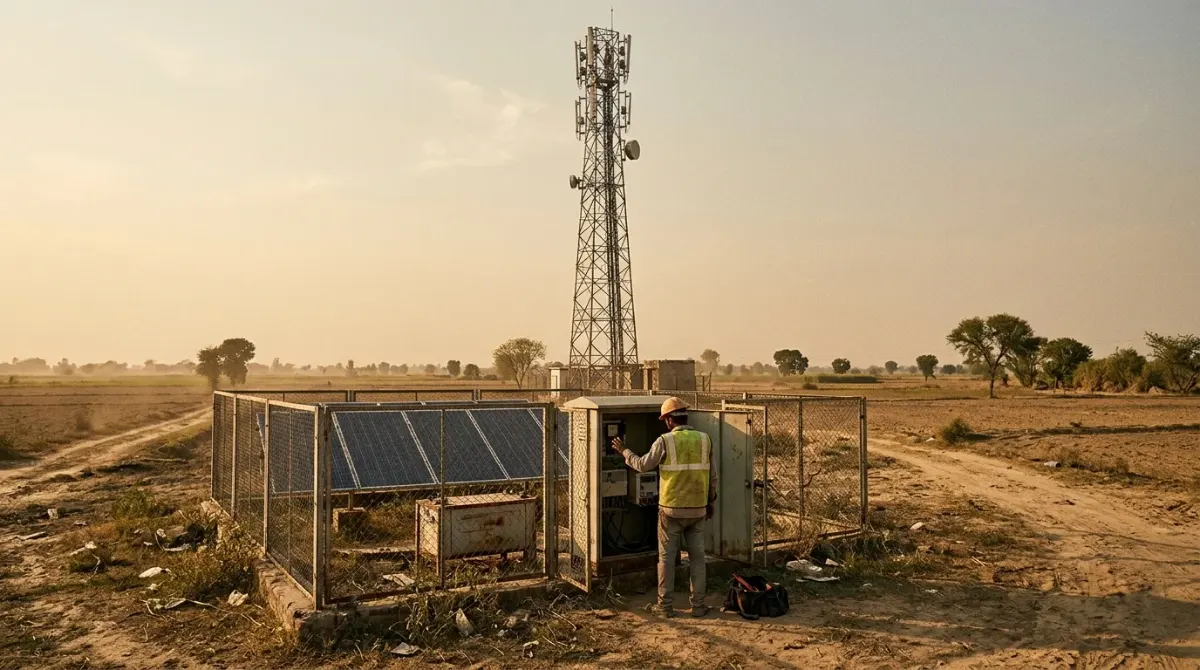
The Pakistan Telecommunication Authority (PTA) has asked mobile operators and tower companies to draw up a phased plan for moving telecom towers onto solar power, battery storage and hybrid energy systems. The aim, according to the regulator, is to cut diesel use, cope with frequent power outages and keep mobile networks running more reliably.
The PTA solar proposal for telecom towers is contained in a consultation paper on an industry-led roadmap for the transition of telecom infrastructure to alternative energy, which the authority placed on its website on 24 November. Telecom companies, tower operators, energy providers and other stakeholders have until 7 December 2026 to send their comments to a dedicated PTA email address, renewable_energy@pta.gov.pk.
At this stage the document is a proposal. No new obligation has been imposed on operators yet, and PTA is explicitly asking the industry whether some of the measures should become mandatory.
What the PTA solar plan for telecom towers asks operators to do
The regulator wants operators and infrastructure providers to submit time-bound plans for converting Base Transceiver Stations (BTS), the cell sites that carry mobile traffic, to alternative energy sources.
As part of those plans, companies have been asked to identify sites that suffer prolonged power outages, assess whether renewable energy is feasible at those locations, and propose investment plans with implementation timelines of one, two or three years.
One of the key questions in the paper is whether solar installations should be made compulsory at BTS sites where monthly outages reach 5% or more. PTA has sought the industry’s view on that threshold before taking a decision.
The proposed roadmap also targets the heaviest diesel users. Operators would be expected to reduce diesel consumption at the 10% of BTS sites that burn the most fuel, and to share details of their current energy use, backup arrangements, grid availability and planned reductions.
Reliability at night and in bad weather
PTA has stressed that any alternative energy setup must keep sites connected around the clock, including at night, during cloudy weather and in other periods when solar generation is low. That points towards hybrid designs that combine solar panels with battery banks, and in some cases grid power or generators, rather than solar alone.
The authority said it is also considering incentives for energy-efficient operators, the sharing of renewable energy infrastructure between companies, and closer coordination with power-sector institutions.
Why power has become a network problem
Electricity supply is one of the biggest operating headaches for Pakistan’s mobile industry. When the grid goes down, towers fall back on batteries and diesel generators, and sites can drop off the network when backup runs out, which users notice as weak signals and dropped calls.
The cost of power has also been on the federal agenda. Earlier this month, ITInsider reported that the Prime Minister’s Office was looking at an industrial power tariff for the telecom sector through a dedicated task force. The tower business itself is changing hands too, with a Bangladesh-focused investor agreeing to buy EDOTCO’s 3,000 telecom sites in Pakistan.
A move towards solar and storage would reduce exposure to diesel prices and load shedding, but it also requires upfront investment at thousands of sites. That is why PTA is asking operators for their own investment plans and timelines rather than setting a single national deadline straight away.
Key facts
- Regulator: Pakistan Telecommunication Authority (PTA)
- Proposal: phased shift of telecom towers (BTS sites) to solar, battery storage and hybrid power
- Plans sought: one, two or three year conversion timelines with investment details
- Question on the table: mandatory solar at sites with monthly outages of 5% or more
- Diesel target: cut use at the 10% highest diesel-consuming sites
- Comments deadline: 7 December 2026, via renewable_energy@pta.gov.pk
FAQ
Is solar now mandatory for telecom towers in Pakistan?
No. PTA has only proposed the roadmap and is asking the industry whether solar should be compulsory at sites with frequent outages.
Who can respond to the consultation?
Telecom operators, tower companies, energy providers and other stakeholders can send feedback to PTA until 7 December 2026.
Will this improve mobile service?
The stated goal is better network reliability during outages. The actual effect will depend on the final rules and how quickly operators invest.
Official sources: PTA consultation papers
Facts and figures checked against official sources by the ITInsider desk.
Featured image: representational, AI-generated