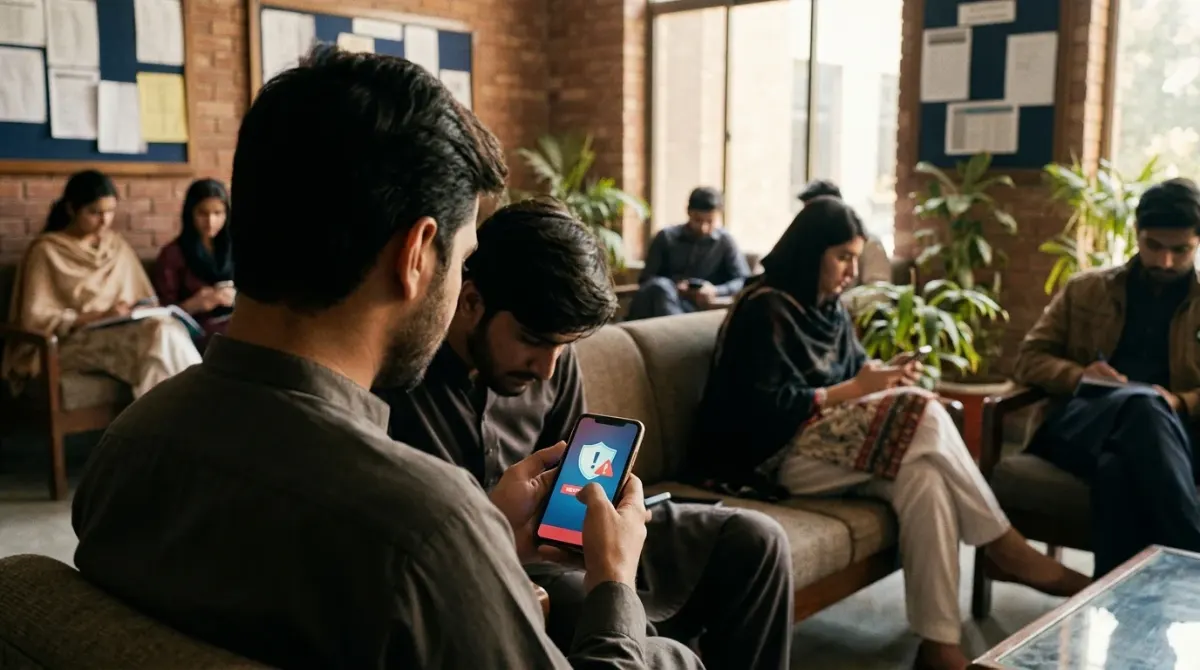
Pakistan’s National Cyber Crime Investigation Agency (NCCIA) has launched a Gen Z Cyber Zone, an online awareness section aimed at young internet users. It is meant to help them recognise online fraud, spot fake links and keep their personal information safe.
The agency announced the initiative in a post on its official X account on 24 November and linked to a dedicated page on its website, nccia.gov.pk.
What the NCCIA Gen Z Cyber Zone covers
According to the NCCIA, the Generation Z Cyber Zone gives young people guidance in five areas:
- How online fraud works and how to recognise it.
- How to identify fake and malicious links.
- Protecting personal information when using apps and online services.
- Responsible use of social media.
- Other basic online safety precautions.
The focus is on both sides of a young user’s online life: what they click on, and what they share. Scams that start with a fake link, a fake job or prize offer, or a request for an OTP or CNIC copy are among the most common complaints in Pakistan’s cybercrime cases, and young users who spend the most time on social media and messaging apps are often the first to see them.
Part of a series of NCCIA awareness pages
The Gen Z section is the latest in a run of audience-specific awareness efforts by the agency. The NCCIA earlier introduced a Kids Corner to teach children about online safety, and recently released a safety guide for older people, which ITInsider covered in its report on the NCCIA senior citizens guide on phone and online fraud.
Splitting advice by age group makes sense because the risks differ. Children need protection from strangers and harmful content, older users are often targeted by impersonation calls and fake bank messages, while young adults face job scams, investment and betting app schemes, account takeovers and the misuse of shared photos.
The NCCIA was set up as a separate agency to handle cybercrime cases under the Prevention of Electronic Crimes Act (PECA), taking over the role previously held by the FIA’s Cyber Crime Wing.
What young users can do now
Alongside the agency’s own guidance, a few habits cut most risks: never share OTPs or passwords with anyone, check the full web address before entering login details, turn on two-step verification on WhatsApp, Instagram, Facebook and email, and be wary of job or investment offers that ask for an upfront fee.
Anyone who becomes a victim of online fraud or harassment can report it to the NCCIA. ITInsider has a step-by-step explainer on how to file a cybercrime complaint with the NCCIA.
Key facts
- Initiative: Generation Z Cyber Zone by the NCCIA.
- Announced: 24 November 2026 on the NCCIA’s official X account.
- Topics: online fraud, fake links, personal data protection, responsible social media use.
- Earlier NCCIA awareness pages: Kids Corner and a guide for senior citizens.
FAQ
Where can I find the Gen Z Cyber Zone?
It is on the NCCIA’s official website, nccia.gov.pk, linked from the agency’s X post.
Who is it for?
Young internet users, mainly teenagers and people in their early twenties.
Official sources: NCCIA on X; NCCIA Gen Z Cyber Zone.
Featured image: representational, AI-generated