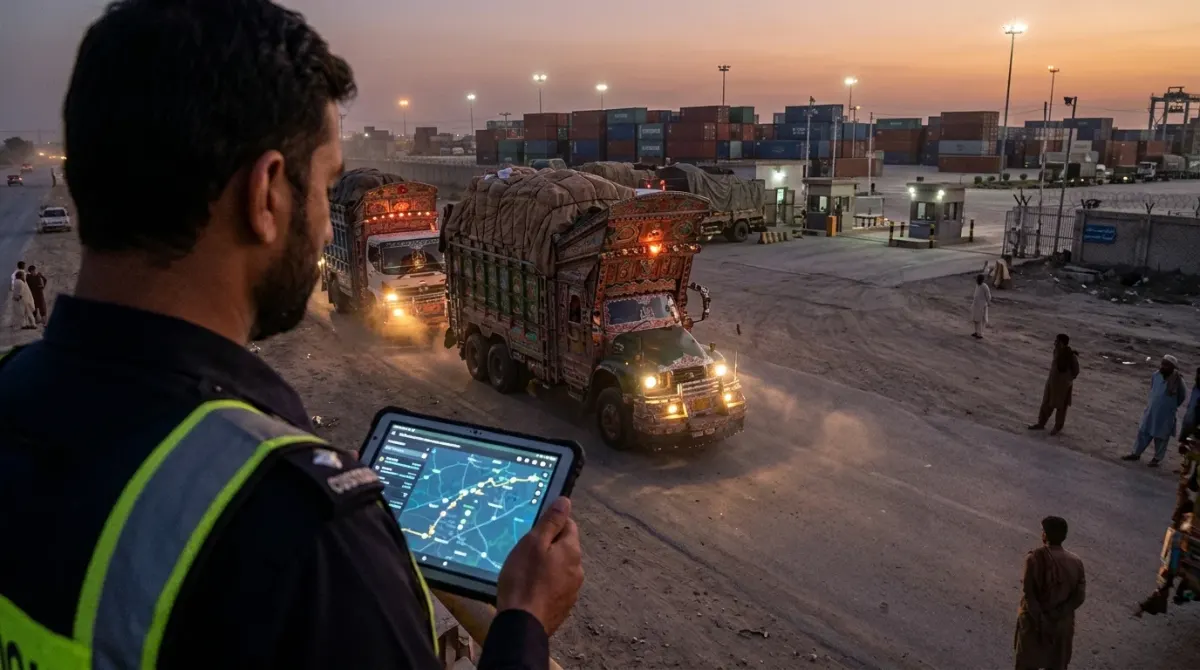
The federal government is building a digital cargo tracking system that will follow goods consignments across Pakistan from the moment they are loaded until they reach their final destination. The aim is to curb smuggling and stop the loss of sales tax revenue that comes with untracked goods.
The plan was reviewed on Tuesday at the weekly meeting on Federal Board of Revenue (FBR) affairs, chaired by Prime Minister Shehbaz Sharif in Islamabad. Officials told the meeting that the new platform would bring the whole cargo tracking process under a single system instead of scattered manual checks.
How the digital cargo tracking system will work
According to the briefing, the system will have four main parts:
- Electronic bilty: a digital version of the goods receipt that transporters issue when cargo is booked, replacing paper slips that are easy to forge or lose.
- Risk management: a layer that flags suspicious consignments for checks.
- Field enforcement: tools for teams on the ground to act on those flags.
- Analytics dashboard: a central view of movement data for decision makers.
A steering committee with representation from the provinces is being formed to oversee implementation. That matters because road freight moves across provincial lines, and provinces collect their own sales tax on services, so a federal system on its own would leave gaps.
No launch date, budget or technology vendor for the system was shared at the meeting.
Enforcement along the Indus and smart scanning at airports
The meeting was also told that the FBR’s Indus Collectorate has started operations at bridges on the River Indus to stop the movement of illegal goods. The unit has deployed 856 personnel and carried out 302 enforcement operations so far, seizing goods worth Rs1.849 billion.
The prime minister directed that smart scanning systems be made operational at all international airports as soon as possible. Officials said the systems are being installed at major airports with help from relevant institutions. They will automatically route passengers’ baggage through green and red channels, which should speed up customs and immigration clearance while tightening checks on high-risk bags.
Sales tax zones and PRAL data security
To improve sales tax collection, the FBR is setting up separate sales tax zones in its four large taxpayer units in Karachi, Lahore, Islamabad and Multan.
The meeting was also briefed on data security at Pakistan Revenue Automation Limited (PRAL), the FBR’s IT company that runs the tax filing and taxpayer systems. Officials said additional security features have been added to several software systems to protect data integrity. Details of the new controls were not made public.
Separately, departmental proceedings are under way against FBR officers accused of issuing unauthorised consumption certificates by misusing tax exemptions that were once available to the former FATA and PATA regions.
The prime minister said he hoped recent visits by the FBR chairman and his teams to Karachi and Lahore would improve engagement with the business community. Officials said those visits had already resolved several issues raised by traders and industrialists, and that the FBR is opening an office at Karachi’s Korangi Industrial Estate to make tax services easier to reach.
Why it matters for Pakistan’s digital economy
Pakistan’s tax reform has leaned heavily on digital tools in recent years, from point-of-sale integration for retailers to faceless processes for taxpayers. ITInsider earlier reported on the FBR’s move to faceless appeals, which takes face-to-face contact out of tax disputes.
A national cargo tracking platform would extend that approach to physical goods on the road. If e-bilty data is linked with sales tax returns, the FBR could match what businesses declare with what actually moved, which is the gap that smuggling and under-invoicing exploit. It would also create a large new government data system, which makes security at PRAL and the agencies running the platform even more important.
For transporters and logistics startups, the practical questions are still open: who will issue e-bilties, whether existing fleet tracking apps can plug in, and what compliance costs will fall on small truckers. ITInsider will follow up as the steering committee shares details.
Key facts
- Digital cargo tracking system to monitor consignments from loading to delivery.
- Components: e-bilty, risk management, field enforcement, analytics dashboard.
- Steering committee with provincial representation being formed.
- Indus Collectorate: 856 personnel, 302 operations, goods worth Rs1.849bn seized.
- PM ordered smart scanning at all international airports.
- Separate sales tax zones in Karachi, Lahore, Islamabad and Multan LTUs.
FAQ
What is an e-bilty?
It is a digital goods receipt issued when cargo is booked with a transporter, replacing the paper bilty used today.
When will the system go live?
No date was announced. A steering committee is being set up to oversee implementation.
Official sources: Weekly meeting on FBR affairs chaired by Prime Minister Shehbaz Sharif, Islamabad, 24 November 2026.
Featured image: representational, AI-generated