
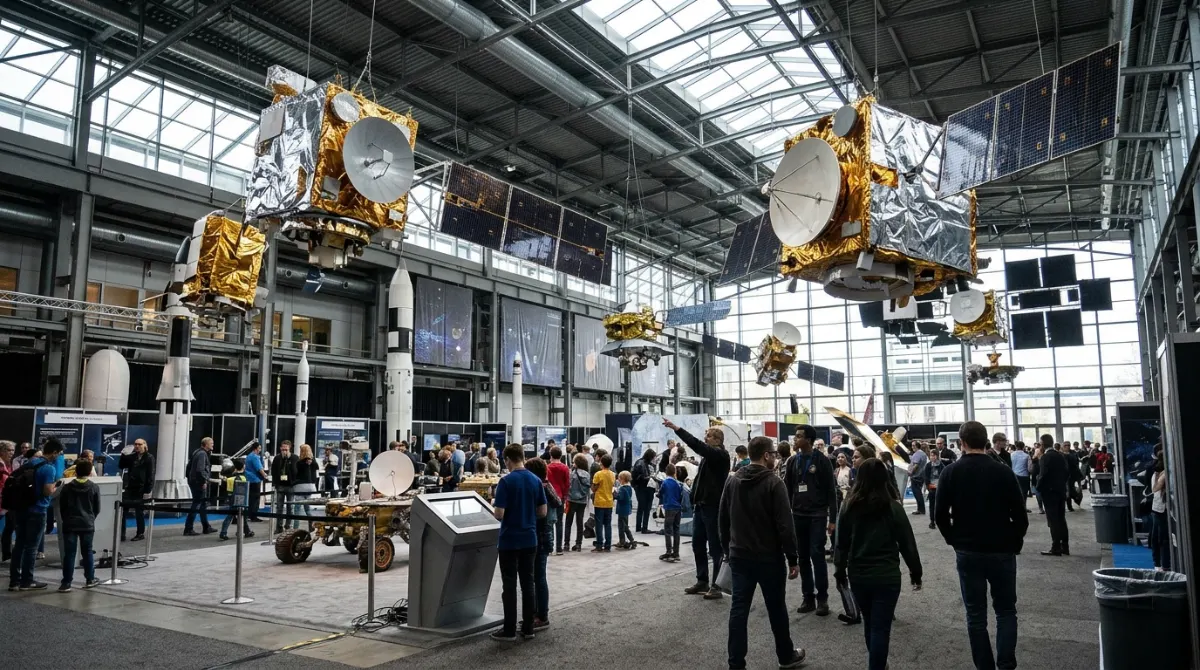
Muslim countries need to invest far more in their own people, research and industry if they want a place in the space economy, experts said at an aerospace technology conference in Islamabad. The three-day International Aerospace Technology Exhibition and Conference is being held at the OIC-Comstech Secretariat from November 11 to 13, according to Dawn.
The event is organised by OIC-Comstech with the Pakistan Vacuum Society and the Pakistan Aerospace Council, with support from partner institutions.
A call to end dependence on imports
Prof M. Iqbal Choudhary, Coordinator General of OIC-Comstech, said space and aerospace technologies are “no longer confined to a few advanced countries.” He called for more investment in people, research, industry and indigenous capability across OIC member states.
He pointed to the wide uses of satellites today, including communications, navigation, weather forecasting, agriculture, water management, disaster response and climate monitoring. Yet OIC countries still rely heavily on imported technologies and services in these areas, he said.
Who is at the aerospace technology conference
About 18 companies, start-ups, research institutions and incubation centres are taking part in the exhibition. Exhibitors named in the report include Trojan, Connectech, Suparco, Air University, NICAT, Citadel and the Pakistan Vacuum Society.
More than 20 technical presentations are scheduled over the three days. Topics include aerospace strategy, satellite platforms, navigation and communications, human spaceflight, space life sciences, earth observation, remote sensing, geospatial AI and vacuum technologies. Speakers from the United States, Azerbaijan and Sudan are also taking part, with sessions on space markets, small satellites, lunar missions and machine learning for geospatial work.
Local capability and the private sector
Chief guest Air Marshal (retd) Javaid Ahmed, President of the Centre for Aerospace and Security Studies, stressed indigenous expertise, human resource development and private sector participation.
Imtiaz Rastgar, founder of the Pakistan Aerospace Council and Chairman of Rastgar Group of Industries, gave a keynote titled “From Dependency to Dominance.” He urged less reliance on foreign technology and stronger links between research, industry and market needs.
Why it matters for Pakistan’s tech sector
Space technology is no longer only a government field. Small satellites, earth observation data and satellite internet are now commercial businesses, and many of them depend on software, data analytics and AI, areas where Pakistan already has skilled engineers.
The presence of start-ups and incubation centres at the exhibition shows that local firms are trying to enter this market. Satellite connectivity is also becoming a live issue in Pakistan, as ITInsider reported when SECP registered six satellite firms including Starlink.
Key facts
- Event: International Aerospace Technology Exhibition and Conference, November 11 to 13.
- Venue: OIC-Comstech Secretariat, Islamabad.
- About 18 exhibitors and more than 20 technical presentations.
- Speakers from the US, Azerbaijan and Sudan.
- Keynote “From Dependency to Dominance” by Imtiaz Rastgar.
FAQ
Who organised the conference?
OIC-Comstech, with the Pakistan Vacuum Society and the Pakistan Aerospace Council.
What was the main message?
OIC countries should cut their dependence on imported space technology by investing in people, research, industry and local capability.
Which Pakistani organisations exhibited?
Exhibitors included Suparco, Air University, NICAT, Trojan, Connectech, Citadel and the Pakistan Vacuum Society.
Official sources: OIC-Comstech; Suparco; Centre for Aerospace and Security Studies
Also reported by: Dawn
Facts and figures checked against official sources by the ITInsider desk.
Featured image: representational, AI-generated