
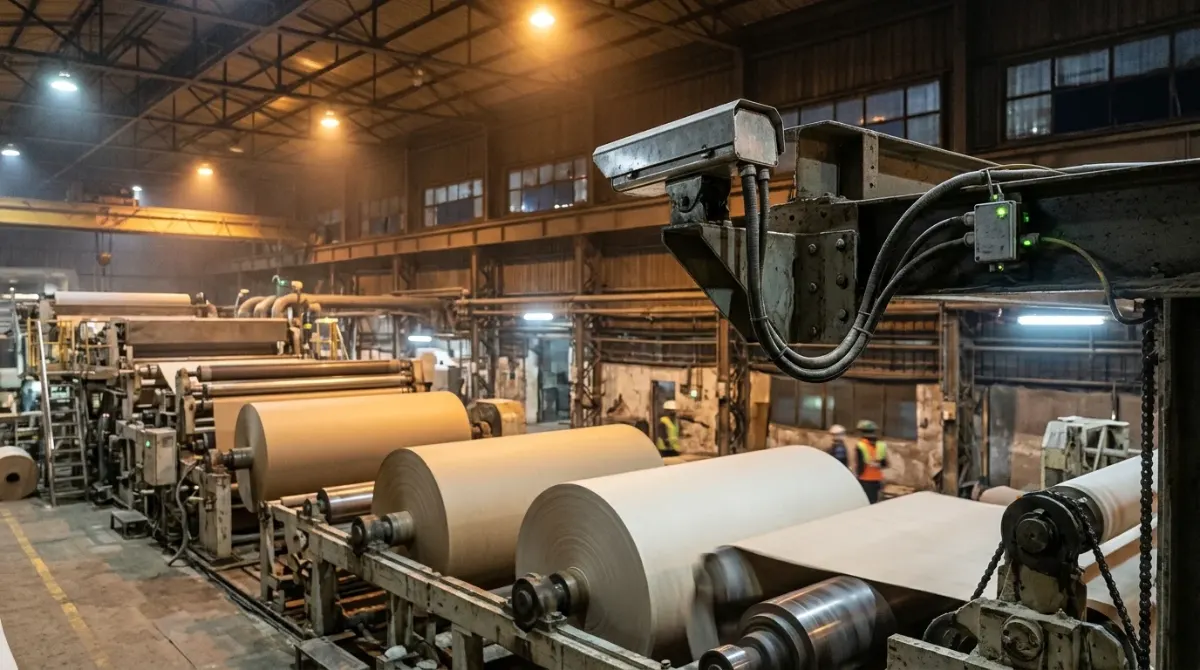
The Federal Board of Revenue (FBR) has made electronic production monitoring compulsory for synthetic leather and paper manufacturers, extending its digital tax-tracking regime to two more industries. Under the new orders, factories must install sensor-based systems and AI-enabled cameras that record every unit produced and send the data straight to the tax authority.
The directives were issued as Sales Tax General Order (STGO) No. 38 and STGO No. 39 of 2026 under Section 40C of the Sales Tax Act, 1990, read with the Sales Tax Rules, 2006. Synthetic and artificial leather producers have until November 30 to install and run the prescribed equipment, while paper and paperboard makers must comply by December 15. The orders took effect immediately.
FBR electronic production monitoring: what synthetic leather makers must install
For the synthetic leather sector, every active roll-producing line must be fitted with sensor-based measurement equipment and AI-enabled cameras. The system is meant to measure the running length of material, identify each finished roll and automatically generate a production record showing length, production time, roll count and video evidence.
The technical specifications are detailed. Measurements must be recorded at a resolution of 0.1 metre, and any gap of more than 0.5 percent between individual roll records and cumulative production triggers an alert. Industrial cameras must be at least four megapixels and record at 25 frames per second. Each roll-cutting event must be captured with a time-stamped image and video covering at least 10 seconds before and after the cut.
The equipment is expected to deliver 99 percent accuracy in measurement and roll counts, with 95 percent set as the minimum acceptable level. Video must be retained for at least 30 days, and production records, snapshots and system logs for at least 90 days. Data will travel to the FBR’s Central Control Unit over secure connections, and the system must stay up for at least 99 percent of each day.
The order covers coating, laminating, finishing, winding, rewinding, inspection and cutting units, including contract manufacturers and composite facilities. The state-owned National Radio and Telecommunication Corporation (NRTC) has been named the authorised vendor for this sector.
Paper and paperboard: units counted by grade and GSM
The second order requires paper and paperboard manufacturers to install systems that can detect, weigh and count production units by grade and grammage, measured in grams per square metre (GSM). Hardware, software and connectivity must be in place at every paper machine and production line by December 15.
The requirement applies to all registered paper and paperboard manufacturers, including composite units, but not to businesses that only cut and print. Where a mill diverts its own paper or board for use in other products on the same premises, that diversion point must also be monitored.
An annex to the order lists 45 registered businesses across tax jurisdictions, among them Century Paper and Board Mills, Bulleh Shah Packaging, Security Papers, Nishat Packaging, Tetra Pak Pakistan and Cherat Packaging. The FBR has said the list is not exhaustive and that eligible manufacturers missing from it are also covered. ISSM Labelling Solutions (Pvt) Ltd has been authorised to supply the monitoring solution for paper.
The new paper rules come on top of STGO No. 27 of 2026, issued on October 7, and video surveillance systems already installed under that order must keep running.
Who pays, and what happens on tampering
Under both orders, manufacturers must provide the infrastructure, electricity, internet connectivity and site access needed for installation, and pay the vendor charges set by the FBR. Finished goods cannot leave the premises unless their production has been electronically monitored and the required records generated.
Synthetic leather makers must report equipment failure, damage or suspected tampering within one hour. Tax officials will be able to match electronically recorded output against sales tax returns, invoices, stock positions, electricity use and purchases or imports of raw materials such as PVC and polyurethane resins, plasticisers and base fabric.
Chief Commissioners Inland Revenue have been told to identify all covered units in their jurisdictions, nominate focal persons and coordinate with the authorised vendors. Violations, including tampering with equipment, hiding production lines or removing unmonitored goods, will be dealt with under the Sales Tax Act and related rules.
Why it matters for Pakistan’s tax-tech push
Electronic monitoring of production has become one of the FBR’s main tools to curb under-reporting in sectors where output is hard to verify from invoices alone. The move to AI-enabled cameras and machine-level sensors shows the authority shifting from simple video surveillance to automated, data-driven checks that can be reconciled with other records in near real time.
For technology vendors such as NRTC and local integrators, the orders also create a sizeable deployment job across dozens of factories within weeks. The FBR’s wider digital overhaul has faced scrutiny this month, including over fake invoices on its IRIS system, which ITInsider covered in its report on the ombudsman’s probe.
Key facts
- Orders: STGO No. 38 and No. 39 of 2026, under Section 40C of the Sales Tax Act, 1990.
- Deadlines: November 30 for synthetic leather, December 15 for paper and paperboard.
- Vendors: NRTC for synthetic leather, ISSM Labelling Solutions for paper.
- Data goes to the FBR Central Control Unit; minimum 99 percent daily uptime.
- 45 paper businesses named in the annex; the list is not exhaustive.
FAQ
Who has to install the systems? All registered synthetic leather manufacturers and all registered paper and paperboard manufacturers, including composite and contract units. Pure cutting and printing businesses are excluded from the paper order.
Who bears the cost? Manufacturers provide the infrastructure, power and connectivity and pay the prescribed vendor charges.
Can goods leave the factory without monitoring? No. Both orders bar removal of finished goods unless production has been electronically recorded.
Official sources: Federal Board of Revenue, Sales Tax General Orders No. 38 and No. 39 of 2026.
Featured image: representational, AI-generated