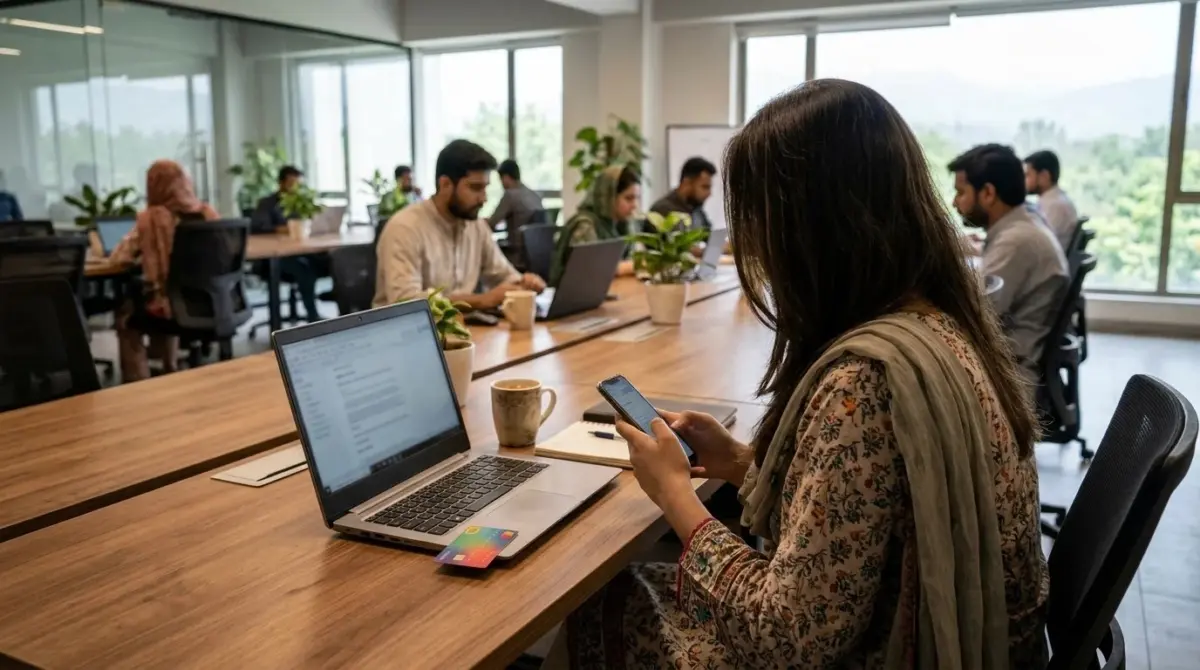
Pakistani freelancers can now open a special bank account that keeps part of their foreign earnings in dollars, without visiting a branch in many cases. The State Bank of Pakistan (SBP) set out the rules in its framework for freelancer accounts in October 2023, and updated the foreign currency rules for IT exporters in 2026. This guide explains what a freelancer digital account and a foreign currency (FCY) account are, what you need to open one and how the dollar retention works.
What is a freelancer account?
Under SBP’s framework, a freelancer account is in fact two accounts opened together:
- A primary rupee (PKR) account for everyday use, cash withdrawals and local payments.
- An Exporters’ Special Foreign Currency Account (ESFCA), which holds the share of your foreign earnings that you keep in dollars or another foreign currency.
Any resident Pakistani who provides digital or online services, including IT and IT-enabled services, and is paid from outside Pakistan is eligible. The accounts can be opened with zero balance and there is no maximum balance limit. Freelancer digital accounts opened before the framework are treated as opened under it.
How much of your income can stay in dollars?
SBP allows IT exporters and freelancers to retain 50% of their export proceeds or $5,000 a month, whichever is higher, in their ESFCA. Banks must credit this amount to the ESFCA unless you ask in writing for a lower amount or none. The rest is converted to rupees.
Money in the ESFCA can be used without SBP’s prior approval for personal and work-related payments abroad, such as software subscriptions, digital marketing, certifications and education. You can convert the balance into rupees at any time. ESFCA funds cannot be moved to other foreign currency accounts, except to another ESFCA of the same exporter.
Documents and information you need
- Your CNIC, NICOP or POC, with issue date
- Full name, father’s or spouse’s name, date and place of birth, and mother’s maiden name
- Mobile number, email address and postal address
- A declaration that your source of funds is freelance work
- A live photo and signature for digital onboarding
The bank verifies your identity through NADRA’s biometric or liveness check, or NADRA Verisys where a biometric check is not possible. For online applications, you will also get a one-time password on your phone or email.
How to open a freelancer account: step by step
- Pick a bank. Most large banks offer a freelancer account. For example, Bank Alfalah offers a Freelancer Digital Savings Account with a USD ESFCA, and Standard Chartered offers a Freelancer Digital Account with an ESFCA.
- Start the application on the bank’s app or website, or at a branch. Some banks still open the ESFCA through a branch.
- Enter your details and upload documents, including your CNIC and a live photo.
- Complete NADRA verification and the OTP check.
- Declare your services. Since April 2026, you make a one-time declaration of the services you provide abroad, and the bank tags the matching purpose code to your account. See our guide on IT and ITeS purpose codes.
- Wait for activation. SBP’s framework sets a decision and activation time of two working days once documents and verification are complete.
- Share your account details with your client or platform, using the IBAN and SWIFT code the bank provides.
Debit cards and withdrawals
Banks must issue a debit card against the ESFCA when an IT exporter asks for one, so that you can pay for online services directly in foreign currency. You cannot withdraw foreign currency cash from the ESFCA inside Pakistan; cash withdrawals in Pakistan are in rupees. Cash withdrawal outside Pakistan with the debit card is allowed.
Limits differ by bank. Standard Chartered, for example, lists a monthly debit and credit limit of $5,000 or equivalent and daily cash withdrawal of Rs500,000 on its freelancer account. Check your bank’s terms.
Common mistakes to avoid
- Using a relative’s account. The account must be in your own name for your earnings to count as your export income.
- Not asking for the debit card. Without it, paying for tools from your dollar balance is harder.
- Forgetting the declaration. If your services are not declared, payments may be tagged under the wrong purpose code.
- Ignoring charges. Accounts are subject to the bank’s schedule of charges and government taxes.
Key facts
- A freelancer account is a PKR account plus an ESFCA, opened together.
- Retention: 50% of proceeds or $5,000 a month, whichever is higher.
- Zero opening balance, no maximum balance.
- Activation within two working days after verification.
- No foreign currency cash withdrawal in Pakistan.
Frequently asked questions
Can I open a freelancer account online?
Yes. SBP’s framework allows remote digital onboarding with NADRA verification, though some banks still need a branch visit for the ESFCA.
Do I need PSEB registration to open one?
No. Any resident Pakistani earning from online services abroad is eligible. PSEB registration helps with tax; see our PSEB guide.
Can I keep all my earnings in dollars?
No. You can retain 50% or $5,000 a month, whichever is higher. The rest is converted to rupees.
Can I send money from my ESFCA abroad?
Yes, for personal and work-related payments, without SBP’s prior approval. Banks must process requests within one working day.
Rules as of November 2026. Check your bank’s current terms.
Official sources: State Bank of Pakistan BPRD Circular No. 5 of 2023 (Framework for Freelancers Accounts) and 2026 FE instructions; bank product pages (Bank Alfalah, Standard Chartered)
Facts and figures checked against official sources by the ITInsider desk.
Featured image: representational, AI-generated