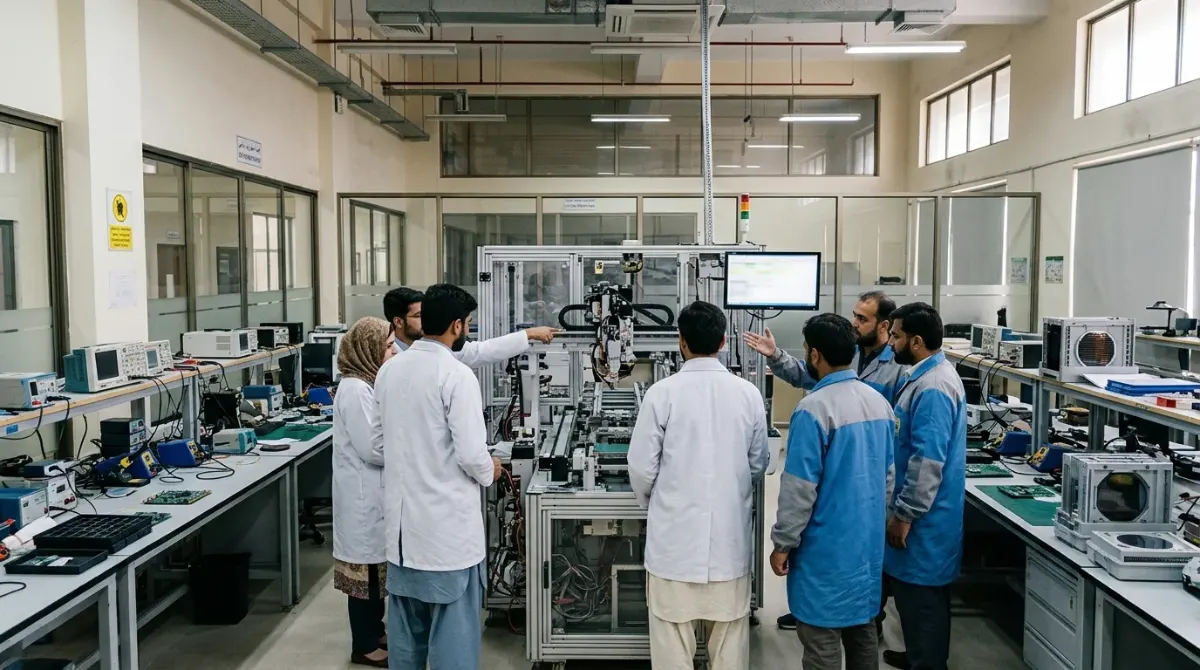
Pakistan plans to set up ten National Catapults, a network of innovation centres meant to help universities, startups and manufacturers turn laboratory research into products that can be sold. Federal Minister for Planning, Development and Special Initiatives Ahsan Iqbal announced the plan this week after visiting IRADA in Islamabad.
The minister presented the National Catapults as a key part of the URAAN Pakistan programme, under its theme of science, technology and engineering for development. IRADA will be the first public enterprise formally given charge of a catapult, leading the Semiconductor and Advanced Electronics Catapult at the start of the rollout.
What the National Catapults are meant to do
Pakistani universities produce a large volume of research papers, but very little of that work reaches the market. The catapult centres are designed to close that gap. They will offer demonstration testbeds, prototyping facilities and pilot production lines where researchers and companies can work side by side.
In the government’s description, a university team could build a prototype together with industry engineers, while a smaller manufacturer could test a new process before investing heavily in a full production line. The minister argued that the benefits would run both ways:
- Investors would be able to judge how a technology performs in real conditions before putting in money.
- Local companies could replace imported products with ones made at home.
- Young engineers, scientists and technicians would find jobs running the facilities.
The ten catapult sectors
The proposed network covers ten strategic areas:
- Semiconductor and Advanced Electronics
- High-Value Manufacturing and Industry 4.0
- Digital Economy and Artificial Intelligence
- Agri Tech and Food Technology
- Health Technology and Med Tech
- Clean Energy and Climate Technology
- Mines, Minerals and Materials
- Defence Technology and Dual-Use
- Space Technology
- Chemicals and Composites
Two of these, semiconductors and the digital economy and AI catapult, are directly linked to the IT sector. Both are areas where Pakistan has so far relied mostly on imported hardware and foreign platforms, while its local strength has been in software services and chip design talent rather than manufacturing.
Key facts
- Announced by: Planning Minister Ahsan Iqbal, November 2026
- Programme: URAAN Pakistan
- Number of hubs: 10 National Catapults
- First lead body: IRADA, for the Semiconductor and Advanced Electronics Catapult
- Focus stage: Technology Readiness Levels 4 to 7
- Models studied: UK Catapult Network, Germany’s Fraunhofer Institutes, Manufacturing USA, Singapore’s A*STAR
Built on international models
The initiative focuses on Technology Readiness Levels 4 to 7. This is the stage between a technology being validated in a lab and being shown to work as a prototype in real conditions. It is often called the “valley of death” for research, because university funding usually stops before this point and private investors are not yet willing to take the risk.
According to the plan, the design draws on the UK’s Catapult Network, Germany’s Fraunhofer Institutes, Manufacturing USA and Singapore’s A*STAR. The UK network, which gave the plan its name, is a group of technology centres that link businesses with researchers in fields such as semiconductors, digital technology and energy.
Apart from helping universities earn from their intellectual property, the government expects the catapults to attract new investment and risk capital. Real-world testing alongside industry is also expected to help shape technical standards, regulations and certification rules.
What it means for Pakistan’s tech sector
For Pakistan’s technology startups and hardware makers, the main value would be access to expensive equipment and testing facilities that few small firms can afford on their own. A shared semiconductor and electronics testbed, for example, could help local design firms move from simulation to working prototypes inside the country.
The announcement does not yet include public details on funding, timelines, or which institutions will lead the other nine catapults. Those details will decide whether the network becomes a working bridge between academia and industry. The plan comes as the government pushes wider digital reforms; Pakistan recently climbed in the UN rankings, as ITInsider reported in our story on the UN E-Government Index 2026.
FAQ
What is a National Catapult?
It is a proposed innovation centre where universities, startups and industry can test and prototype technologies before full commercial production.
How many catapults are planned?
Ten, covering sectors from semiconductors and AI to space technology and agriculture.
Who will lead the first one?
IRADA has been named to lead the Semiconductor and Advanced Electronics Catapult.
Has funding been announced?
No public funding figures have been shared so far.
Official sources: Ministry of Planning, Development and Special Initiatives; statements by Federal Minister Ahsan Iqbal (November 2026)
Featured image: representational, AI-generated