
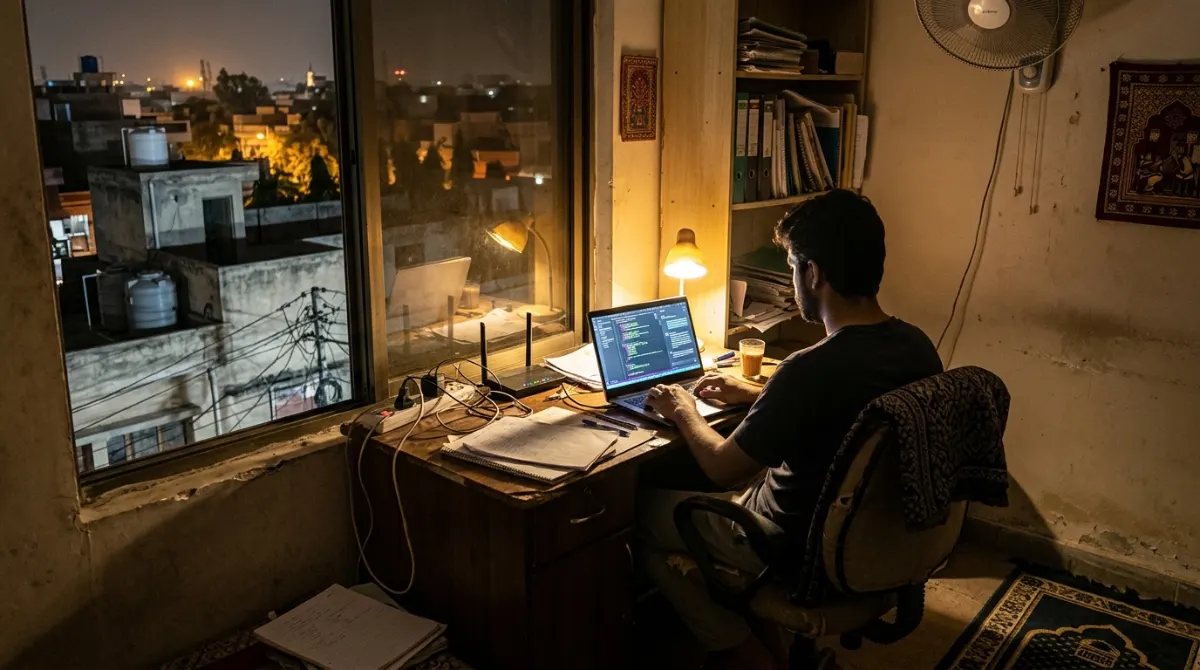
Nearly a quarter of Pakistani freelancers work in jobs that artificial intelligence could disrupt, the State Bank of Pakistan (SBP) has warned. In its annual report on the State of Pakistan’s Economy for FY26, released on Monday, the central bank said 23.2 percent of the country’s freelancers are engaged in occupations exposed to AI, including programming, web development and research writing. The finding puts a number on a concern that many Pakistani freelancers and AI watchers have raised for two years.
The report does not say these jobs will vanish. It says the work is exposed, and that freelancers will need training at scale to upgrade their skills and stay competitive as AI tools change what clients buy on global platforms.
What the SBP report says about Pakistani freelancers and AI
According to the central bank, online gig workers in Pakistan often lack structured training, professional feedback and a clear path to specialised skills. They also face more job insecurity and a higher risk of unemployment than other workers in the informal sector. Income growth is limited, the report notes, especially in lower-skill online work.
The occupations the SBP flagged are some of the most common on freelance marketplaces: coding, website building and writing-based research tasks. These are also areas where generative AI tools have improved quickly, allowing clients to do some work in-house or pay less for it.
The SBP’s recommendation is broad rather than specific: large-scale training opportunities so that freelancers can move into higher-value work. Programmes such as DigiSkills, NAVTTC courses and provincial schemes already exist, and ITInsider has covered several of them, including the free NAVTTC and IBM IT courses opened earlier this month.
A young, city-heavy workforce
The report gives a detailed picture of who Pakistan’s online gig workers are. Around 67 percent are aged between 15 and 29, compared with 32 percent of workers in similar occupations across the wider labour market. That matches the country’s demographics: according to the Ministry of Planning, Development and Special Initiatives, 58.3 percent of Pakistan’s population is under 25, and the 15-29 age group is projected to reach 99.8 million by 2050.
The SBP also pointed to a gap between big cities and smaller towns. Tertiary cities account for 36 percent of Pakistan’s online gig workers. The comparable share is 44 percent in Bangladesh, 41 percent in India, 71 percent in Mexico and 78 percent in China.
The central bank linked Pakistan’s weaker showing outside major cities to poor digital infrastructure, internet disruptions, limited education and English skills, and unreliable electricity. It warned that these structural problems could stop freelancing from becoming a sustainable source of productive jobs.
Small share of gig work, big share of global supply
Web-based work is still a small slice of Pakistan’s gig economy. The report says 97.1 percent of the country’s gig workers are in location-based services such as delivery and ride-hailing, which usually come with lower productivity and informal arrangements. Online freelancing makes up less than 3 percent of the total gig workforce.
Even so, Pakistan is one of the leading markets for online platform work. The SBP cited Payoneer rankings and noted that Pakistan, India and Bangladesh together supply nearly half of the world’s online gig workers. Pakistan’s web-based gig export earnings have doubled to about $1.5 billion over the past two years, according to the report.
Industry view
Pakistan Freelancers Association (PAFLA) chairman Ibrahim Amin, speaking to ProPakistani, said AI brings both risks and opportunities, and urged freelancers to adopt AI tools and sharpen their skills. He said freelance export receipts were close to $550 million in the first quarter of this fiscal year and could cross $2.5 billion for the full year if the trend holds. That projection is his own estimate, not an SBP forecast.
What it means for Pakistan
The report lands at a time when the government counts IT and freelance remittances as a key source of foreign exchange. If almost one in four freelancers works in AI-exposed roles, training budgets may need to shift from basic digital skills towards AI-assisted development, data work, cybersecurity and specialised writing that clients still pay a premium for.
The SBP said creating enough jobs for a fast-growing young workforce remains a major challenge. Better digital infrastructure, education and specialised training, it said, will decide whether Pakistan gains from the global gig economy or loses ground to AI.
Key facts
- 23.2% of Pakistani freelancers work in AI-exposed occupations (SBP, FY26 annual report).
- About 67% of online gig workers are aged 15-29.
- Tertiary cities hold 36% of online gig workers, below India (41%) and Bangladesh (44%).
- Web-based gig export earnings have doubled to about $1.5 billion in two years.
- Online freelancing is under 3% of Pakistan’s total gig workforce.
FAQ
Which freelance jobs are most exposed to AI? The SBP named programming, web development and research writing among the exposed occupations.
What does the SBP recommend? Large-scale training so freelancers can upgrade skills, along with better digital infrastructure and education.
Official sources: State Bank of Pakistan, Annual Report on the State of Pakistan’s Economy FY26; Ministry of Planning, Development and Special Initiatives (population data).
Also reported by: ProPakistani.
Facts and figures checked against official sources by the ITInsider desk.
Illustrative image (AI-generated)