
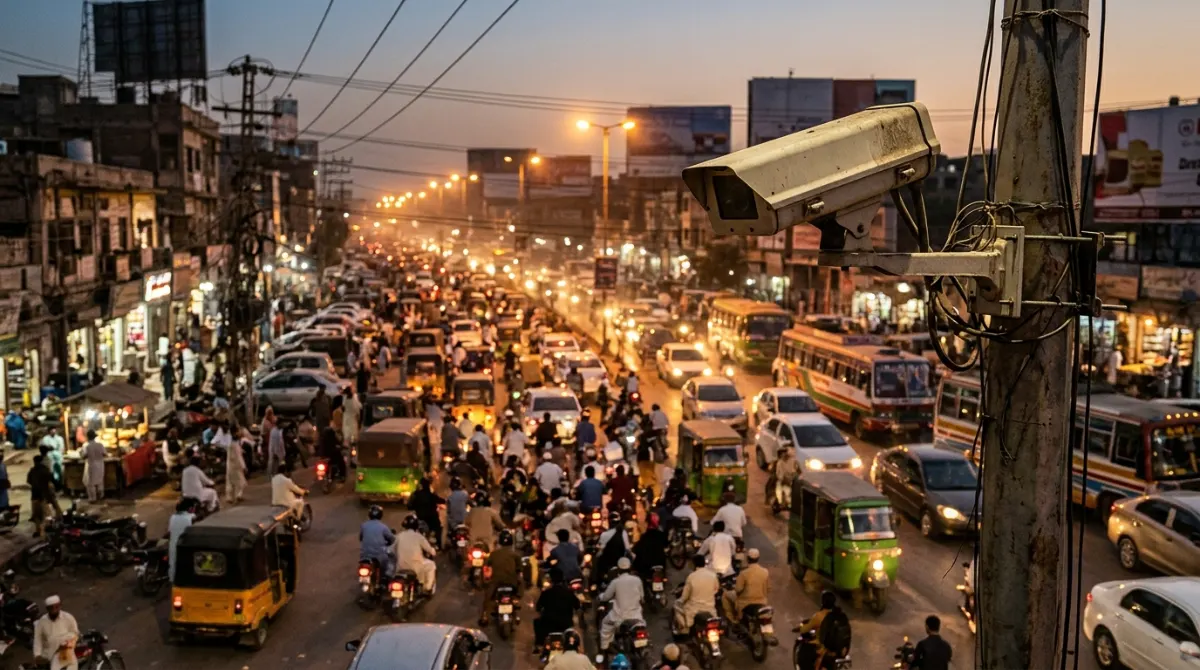
Karachi e-challans have crossed 1.947 million in the first year of the city’s camera-based traffic ticketing system, with fines of more than Rs5 billion imposed on motorists, according to figures shared by Karachi traffic police officials on Monday.
Of that amount, motorists have paid more than Rs2 billion into the national exchequer, while challans worth around Rs3 billion were waived. Officials said more than 330,000 tickets generated through the Traffic Regulation and Citation System (TRACS) were written off under the waiver.
The data offers the clearest picture yet of how Sindh’s largest digital enforcement project has performed since it went live in October 2025, replacing much of the old roadside ticketing by traffic wardens with automated detection by surveillance cameras.
Karachi e-challans: helmets and seatbelts top the list
Two basic safety violations account for most of the tickets. Motorcyclists riding without helmets received more than 814,000 challans, the single largest category. Drivers not wearing seatbelts followed with more than 715,000 tickets.
Together, these two offences make up close to 80 percent of all e-challans issued in the first year, which suggests the cameras have mostly been catching everyday behaviour rather than rare, high-risk driving.
Other moving violations were far smaller in number. Police recorded 65,255 overspeeding cases, 36,474 tickets for using a mobile phone while driving and 34,652 for driving on the wrong side of the road. Signal violations stood at 7,975, while lane discipline breaches were logged 2,301 times.
Paperwork, number plates and parking
A significant share of tickets related to vehicle documentation rather than driving. Officials said 54,443 challans were issued to vehicles without fitness certificates and 18,519 to vehicles whose certificates had expired.
More than 11,000 vehicles were fined for fancy number plates and 5,401 for concealed plates, while 3,156 challans went to vehicles operating without a tracker. Another 5,136 vehicles were ticketed for tinted or blackened windows.
Parking and road-use offences added to the total. Illegal parking led this group with 78,377 e-challans, followed by 20,505 for obstructing traffic flow and 7,516 for crossing stop lines, misusing designated lanes or violating zebra crossings.
Key facts
- Total e-challans in year one: more than 1.947 million
- Fines imposed: over Rs5 billion
- Paid into the national exchequer: over Rs2 billion
- Waived: around Rs3 billion, covering more than 330,000 challans
- Most common violation: riding without a helmet (814,000+)
- Second most common: no seatbelt (715,000+)
- System: Traffic Regulation and Citation System (TRACS), launched October 2025
What the first year shows about digital enforcement
The figures point to a large gap between tickets issued and money collected. With roughly Rs2 billion paid against Rs5 billion imposed, well under half of the fines have reached the treasury so far, and a bigger amount has been waived than collected.
Waivers were part of the system’s design from the start. In January, Dawn reported that a significant share of tickets were being waived for first-time offences, and that delivery of e-tickets to registered home addresses was running into problems such as changed or incomplete addresses. At that stage, a little over 288,000 e-tickets had been generated, so the volume has grown several times over since.
Officials have said the system was introduced to improve traffic regulation, push compliance with road safety rules and strengthen enforcement through modern surveillance technology. Karachi police have also used the same data to blacklist thousands of vehicles with fake or incomplete number plates and unregistered ownership transfers, with the list shared with Safe City cameras.
For Pakistan’s wider digital governance push, Karachi’s experience is a useful test case. Punjab has expanded its own camera-based enforcement and is now using AI cameras for other public uses, as ITInsider reported in its story on Punjab AI cameras flagging out-of-school children. The Karachi numbers show that automated detection can scale quickly. Whether it changes behaviour on the road, and whether collection and delivery of tickets can keep pace, will be the real measure in year two.
FAQ
How many e-challans has Karachi issued in the first year?
More than 1.947 million, according to Karachi traffic police officials.
What is TRACS?
The Traffic Regulation and Citation System is Karachi’s digital e-challan system, which uses surveillance cameras to detect violations and generate tickets.
How much money has been collected?
Officials said motorists paid more than Rs2 billion of over Rs5 billion in fines, while around Rs3 billion was waived.
Official sources: Karachi traffic police data on the first year of TRACS; Sindh Police briefing reported by Dawn (January 2026).
Also reported by: 24 News, Daily Times.
Facts and figures checked against official sources by the ITInsider desk.
Illustrative image (AI-generated)