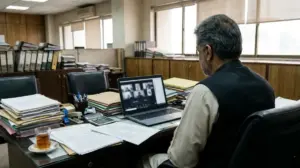
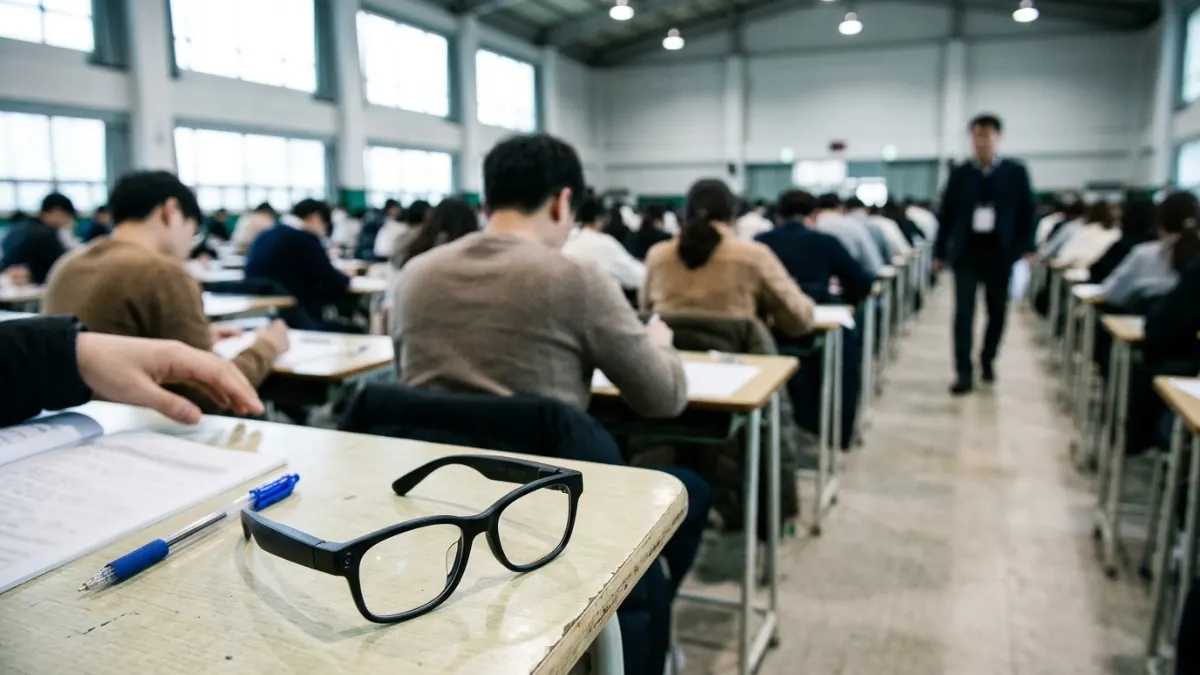
The top scorer in South Korea’s national tax accountant exam has confessed to AI cheating, admitting he used a hidden camera and a generative AI tool to answer questions during the test. The case has prompted a police investigation, a move to suspend his licence and promises of tougher exam security days before the country’s main university entrance test.
The man, a 34-year-old identified by The Korea Herald as Han Won-seok, turned himself in to the Seoul Metropolitan Police Agency through his lawyer on Sunday, November 15. A masked confession video was posted the same day on the YouTube channel of his attorney, Lee Don-ho of Nova Law Firm.
How the AI cheating worked
According to his confession, he photographed exam questions with a miniature camera, sent the images to an AI system and read the answers on a smartphone. He said he used electronic devices and generative AI in both stages of the 63rd tax accountant qualification exam, and used the same method in the first stage of the certified public accountant exam in March.
His lawyer did not reveal the exact technique, saying others could copy it. Some of the devices were damaged, and the examinee plans to hand over the remaining equipment to police as evidence. The Korea Herald described the device as AI-powered smart glasses.
Scores that raised suspicion
The exam is run on the government’s behalf by the Human Resources Development Service of Korea (HRDK). In the first stage in April, he scored 397.5 out of 400, answering 159 of 160 multiple-choice questions correctly, with perfect marks in introductory tax law, introductory accounting and commercial law.
Those results stood far above the field. In introductory tax law, the 16,856 candidates averaged 30.18 points, and about 74 percent scored below the 40-point minimum needed to pass the subject, according to HRDK grading data cited by Korean media. Candidates get roughly one minute per question.
He also ranked first in the essay-based second stage in July, scoring 663 out of 800. Only 722 of 6,606 second-stage candidates passed, a rate of 10.92 percent.
After he posted his results on his blog, fellow candidates and practising tax accountants began to suspect AI glasses. He first denied the claims in a media interview, saying he solved unfamiliar questions by elimination. Officials said two proctors were assigned to his exam room, which raises questions about how the cheating went unnoticed.
Government response
The police case has been assigned to the Seoul police’s Provincial Special Detective Corps. The Ministry of Finance and Economy plans to suspend the validity of his tax accountant certificate through a qualification review committee under the National Tax Service, saying a confession alone is not enough to revoke it outright. The ministry is also reviewing how the exam is administered and supervised.
Presidential chief of staff Lim Kwang-hyun said the matter was being treated seriously ahead of the CSAT, the national college entrance exam held on Thursday. Prime Minister Han Seong-sook pledged zero tolerance for exam cheating, and the Korean Association of Certified Tax Accountants asked authorities to investigate. South Korea reported its first exam cheating cases involving AI smart glasses earlier this year, and proctors are being trained to spot such devices.
What it means beyond Korea
The case shows how cheap cameras and AI models that read images can defeat traditional invigilation, even in a high-stakes professional exam with two proctors in the room. Exam bodies that rely mainly on human supervision and paper-based multiple-choice tests face the same risk.
That includes Pakistan, where millions sit board, admission, recruitment and professional exams each year. Device detection, signal checks and question formats that are harder to photograph and solve instantly are likely to become standard tools for test organisers. ITInsider has also tracked how AI is changing other kinds of risk, from AI-fuelled ransomware attacks to fraud aimed at online shoppers.
Key facts
- Exam: South Korea’s 63rd tax accountant qualification exam, run by HRDK
- First stage score: 397.5 out of 400; second stage: 663 out of 800, ranked first
- Method: miniature camera, generative AI tool and smartphone
- Status: confession submitted to Seoul police on November 15; licence suspension planned
- Also admitted: same method in the CPA exam’s first stage in March
FAQ
Was the examinee arrested?
No arrest or charge has been reported yet. He turned himself in and police have opened an investigation.
Will he lose his tax accountant qualification?
The finance ministry plans to suspend the certificate first while facts are verified, then decide on revocation.
Why does it matter now?
The confession came days before the CSAT, South Korea’s national university entrance exam.
Official sources: Human Resources Development Service of Korea (grading data), Ministry of Finance and Economy, Seoul Metropolitan Police Agency, as cited by The Korea Herald and Korea JoongAng Daily
Also reported by: Bloomberg, The Korea Times, Dawn, Express Tribune, The News
Facts and figures checked against official sources by the ITInsider desk.
Featured image: representational, AI-generated