

ITInsider Research | Pakistan’s AI Future Series, No. 01. Research and analysis by Mohammad Awais.
Pakistan’s young workforce, growing technology exports and emerging robotics industry present new opportunities in the global AI economy. But skills shortages, graduate unemployment and the changing economics of freelancing could determine whether the country benefits from the transition or struggles to keep pace.
Pakistan’s AI workforce transition: key figures
| Indicator | Reported figure |
|---|---|
| Global jobs projected to be created by 2030 (WEF) | 170 million |
| Global jobs projected to be displaced by 2030 (WEF) | 92 million |
| Net global job growth projected (WEF) | 78 million |
| Workers’ skills expected to change or become outdated (WEF) | 39% |
| Pakistan working-age population (PBS 2024–25) | 179.6 million |
| Pakistan labour force, 19th ICLS (PBS 2024–25) | 83.1 million |
| Pakistan employed people, 19th ICLS (PBS 2024–25) | 77.2 million |
| Pakistan ICT exports, July–March FY2026 | US$3.388 billion |
Introduction
Artificial intelligence is changing the way businesses operate, professionals work and companies recruit employees. From automated customer services and AI-assisted software development to robotics and data analytics, technologies once limited to specialised research environments are increasingly becoming part of everyday business operations.
For Pakistan, this transformation presents an important economic question: can artificial intelligence become a source of new employment and export opportunities, or will it deepen existing challenges in an already competitive labour market?
The question is particularly relevant for a country with a large young population, millions of people entering the workforce and an expanding information technology sector. While AI is creating demand for new technical capabilities worldwide, it is also changing the value of traditional professional services, including content production, administration, data processing and routine software development.
According to the World Economic Forum’s Future of Jobs Report 2025, technological developments and other structural changes are projected to create 170 million jobs and displace 92 million jobs globally by 2030, resulting in a net increase of 78 million jobs. The report also estimates that 39 per cent of workers’ existing skills could be transformed or become outdated by 2030.
These are global projections covering several economic and technological trends, rather than an estimate of jobs that AI alone will create or eliminate. For Pakistan, the challenge is not simply adopting AI tools. It is preparing workers to participate in an economy where technological capabilities, professional expertise and adaptability will increasingly determine employment opportunities.
Pakistan’s labour market faces an AI transition
Pakistan’s employment structure provides an important starting point for understanding the potential impact of artificial intelligence.
According to the Pakistan Bureau of Statistics’ Labour Force Survey 2024–25, the country’s working-age population reached 179.6 million. Under the survey’s 19th International Conference of Labour Statisticians (ICLS) framework, the labour force stood at 83.1 million, with 77.2 million employed people and 5.9 million unemployed people.
The survey’s 13th ICLS series reports an unemployment rate of 6.9 per cent in 2024–25, compared with 6.3 per cent in 2020–21. Youth unemployment among people aged 15–24 increased from 11.1 per cent to 12.5 per cent under that same framework. Under the newer 19th ICLS methodology, the overall unemployment rate was 7.1 per cent and youth unemployment was 12.8 per cent. These figures use different statistical frameworks and should not be mixed.
The figures reveal an existing employment challenge that could become more complicated as businesses introduce AI-assisted processes and automation. AI’s impact will not be confined to software companies or technology professionals; it could gradually influence employment requirements across agriculture, manufacturing, retail, transport, education and services.
AI could reshape Pakistan’s freelance economy
One of the areas where the effects of artificial intelligence are becoming particularly important is Pakistan’s freelance and digital services industry.
Pakistan has developed a significant presence in international freelancing, providing services such as software development, graphic design, digital marketing, content writing, customer support and virtual assistance. Generative AI is changing how international clients purchase these services. Businesses can use AI tools to generate initial content, analyse information, prepare presentations, write software code and automate routine administrative activities.
Pakistan’s Labour Force Survey 2024–25 estimates that approximately 2.2 million people were engaged in online gig work as their main activity, equivalent to 2.9 per cent of total employment. A further 190,000 people undertook such work as a subsidiary activity.
A Pakistan Business Council study, Expanding Pakistan’s IT Footprint, found that the median value of recorded freelance transactions declined from US$106 in FY2021 to US$63 in FY2025, a fall of approximately 41 per cent, despite a 114.6 per cent increase in the number of recorded freelance export transactions.
The findings suggest pressure in the value of individual transactions. They do not establish that AI alone caused the change or that every freelancer experienced lower earnings. The PBC also estimates that approximately 43,000 IT graduates enter Pakistan’s annual graduate cohort, while only 10–12 per cent are immediately employable without substantial additional preparation.
Freelancers who develop expertise in AI integration, data analytics, cybersecurity, software architecture, specialised content strategy and business automation could be better positioned to compete for higher-value international assignments.
Pakistan’s ICT exports demonstrate the opportunity
Pakistan’s technology sector continues to expand its contribution to the economy. According to the Pakistan Economic Survey 2025–26, ICT export remittances reached US$3.388 billion during July–March FY2026, compared with US$2.829 billion during the corresponding period of the previous fiscal year, an increase of 19.7 per cent.
The performance demonstrates the growing importance of technology-based services in Pakistan’s external trade. AI could support this transition by helping companies improve productivity, serve international clients and develop services that previously required larger operational teams.
Higher export earnings alone do not establish that the benefits of technological growth are reaching the wider workforce. The next stage will depend on whether Pakistani businesses can move towards more specialised services, develop technology-based products and create higher-skilled employment.
Case study: World Context turns Pakistani factory work into AI training data
One of the most interesting examples of Pakistan’s emerging role in the global artificial intelligence industry is the Karachi-based startup World Context.
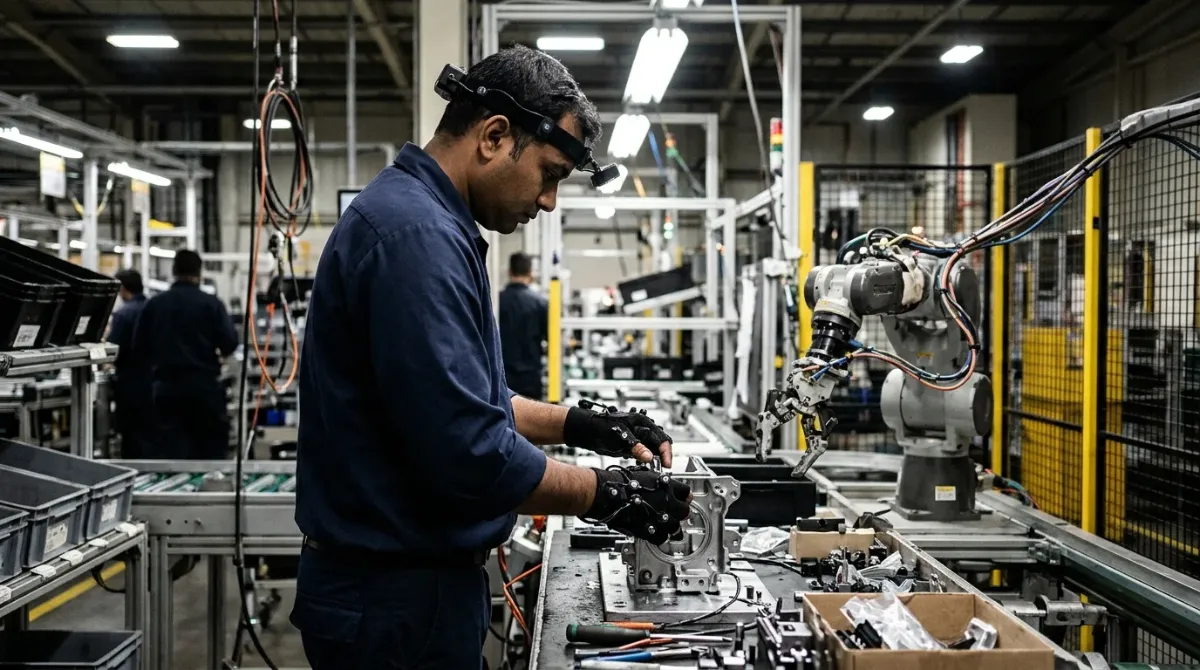
Founded in January 2026, the company records factory workers performing industrial tasks through specialised sensors, wearable gloves and head-mounted cameras. The recordings are converted into datasets that can help robotics companies train machines to perform physical activities.
In July 2026, the company said it was collecting data from approximately 8,000 workers across textile, automotive, logistics and other manufacturing sectors. The recordings capture details such as hand movements, finger positions, object handling and the pressure applied during industrial activities.
From factory-floor experience to robotics training
The model places practical industrial knowledge at the centre of AI development. A worker who understands how to handle materials, assemble components or operate machinery possesses expertise that can help train machines to perform similar tasks.
The process involves recording human activity, structuring the resulting information and making it useful for robotics developers. Such datasets can help train systems to recognise objects, understand sequences of movement and learn how tasks are performed in real environments.
This is significant for Pakistan because it points to a possible role in the AI supply chain beyond conventional software development. Industrial workers, data annotators, technicians and engineers could contribute different forms of expertise to the development of robotics systems.
A worker’s perspective: opportunity and concern
The same development also raises concerns about employment security. In media interviews, factory worker Sunny Manzoor, who took part in the data-collection process, expressed concern that automation could eventually reduce the need for human labour.
His concern reflects a wider challenge: if workers’ movements and expertise are used to develop increasingly capable machines, how will they benefit from the technology they are helping create?
Any expansion of this model should address informed consent, worker compensation, data ownership and safeguards against displacement. The commercial opportunity should not come at the expense of workers whose experience helps create the underlying datasets.
From Lahore to international robotics research
World Context’s activities have also expanded beyond data collection. In September 2026, the company hosted a robotics hackathon at the University of California, Berkeley, bringing together 13 teams to develop projects using its datasets.
The company also held a Narration Sprint in Lahore, where participants described factory footage to generate additional information for training vision-language and vision-language-action models.
This introduces another potential employment category: people who can interpret, describe and structure real-world industrial activities for AI training. It also demonstrates how opportunities can emerge beyond conventional software development.
The reported figures and activities should not be interpreted as evidence that thousands of traditional factory jobs have already been replaced or that the business model has been proven at national scale. They demonstrate an emerging model whose long-term employment and export potential still needs to be assessed.
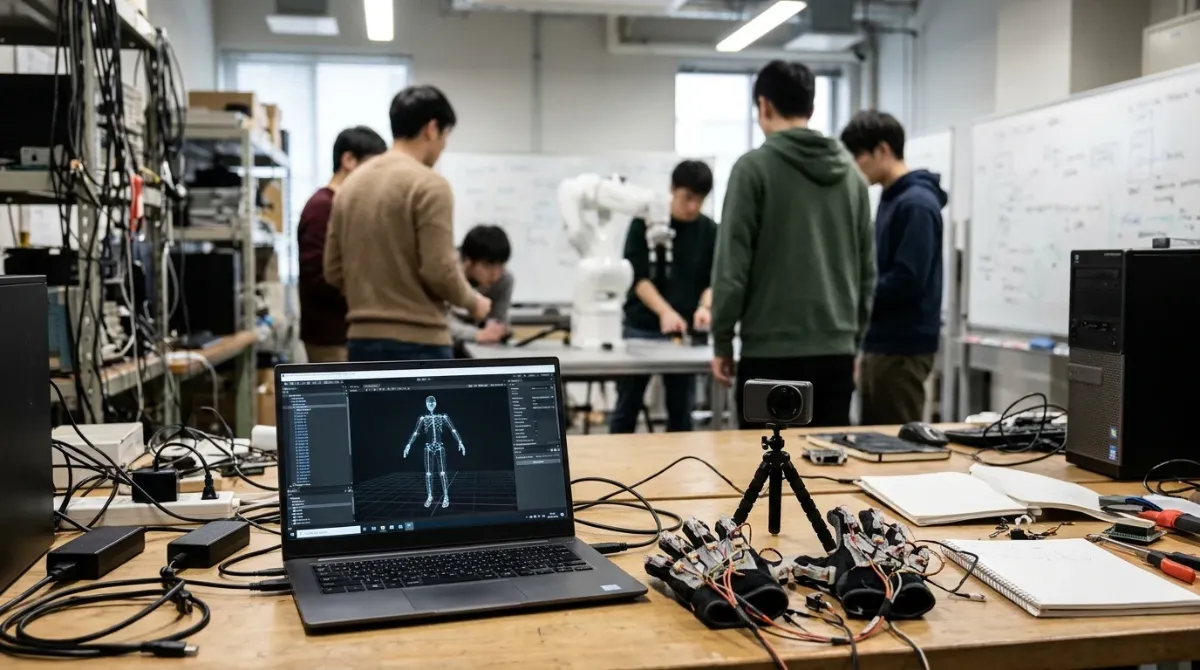
Which professions in Pakistan could be affected by AI?
The effects of AI will vary across industries, depending on the nature of the work and how businesses implement new technologies.
In banking and financial services, AI can support customer assistance, transaction monitoring, fraud detection and financial analysis. Routine administrative activities could become increasingly automated, while demand may grow for professionals in cybersecurity, compliance, risk management and AI governance.
In media and communications, generative AI can assist with transcription, translation, background research, content preparation and data analysis. Original reporting, source verification, editorial judgement, investigative research and strategic communication continue to require human expertise.
In education, AI-powered learning platforms can support personalised instruction, lesson preparation and student assessment. This could create opportunities for education technology specialists and digital learning designers.
Manufacturing could experience greater adoption of robotics, automated inspection, predictive maintenance and production monitoring. Agriculture could benefit from AI-powered crop monitoring, satellite imagery, disease detection, weather forecasting and precision farming.
AI generally affects individual tasks before it transforms entire occupations. A professional whose work involves several responsibilities may use AI to complete certain tasks more efficiently without losing the need for human judgement and experience.
Pakistan’s National AI Policy sets a workforce target
The Government of Pakistan introduced its National Artificial Intelligence Policy 2025 through the Ministry of Information Technology and Telecommunication.
The policy establishes six pillars covering AI innovation, awareness and readiness, a secure AI ecosystem, industrial transformation, infrastructure and international partnerships.
One of its workforce-related targets is to train one million new and existing IT graduates in AI and allied technologies by 2027. It also sets a target of preparing 10,000 trainers to support the development of AI skills.
These objectives reflect the government’s intention to develop human capital alongside the country’s wider digital infrastructure. However, policy targets should not be confused with completed achievements. The real measure of success will be the number of people who complete training, secure employment, improve their earnings or use AI capabilities to establish sustainable businesses.
The skills Pakistani workers will need by 2030
The World Economic Forum identifies AI and big data, networks and cybersecurity, and technological literacy among the fastest-growing skills globally. Analytical thinking, creative thinking, resilience, flexibility and collaboration will also remain important.
For Pakistan, preparing the workforce will require a combination of technical capabilities and professional expertise. AI literacy should become an essential skill across academic disciplines. Students in business, finance, medicine, agriculture, engineering, education and communications should understand how AI can be applied within their respective industries.
Data analysis, cybersecurity and data protection will also become more significant as organisations integrate AI into their operations. At the same time, communication, problem-solving, critical thinking, leadership and professional judgement will remain important.
Pakistan does not need every graduate to become a software engineer. It needs accountants who can use AI for financial analysis, journalists who can verify AI-assisted research, agricultural professionals who understand precision farming and healthcare specialists who can evaluate technology-supported diagnostic systems.
Can AI create opportunities for women and young graduates?
Remote work, online services and technology-enabled businesses can provide greater flexibility for women and young professionals who may have limited access to conventional employment opportunities.
However, access to reliable internet, affordable devices, professional training and safe digital working environments remains important. AI could help workers improve productivity, reach international clients and develop specialised services.
For university graduates, the priority should be practical exposure. Employers increasingly need people who can demonstrate how they use technology to solve real problems rather than simply list AI-related courses on their CVs. Universities and training institutions should therefore strengthen internships, industry partnerships, applied projects and employment-focused training.
What Pakistan needs to do to prepare its workforce
Pakistan’s transition towards an AI-enabled economy will require coordinated action from the government, private sector, universities and technology industry.
First, AI education should extend beyond computer science programmes. Universities should introduce relevant applications across business, agriculture, finance, healthcare, media and engineering.
Second, professional training programmes should focus on employment outcomes. Their performance should be measured through job placements, practical competencies, earnings and employer satisfaction rather than enrolment numbers alone.
Third, Pakistan’s freelance industry needs to move towards specialised and higher-value services. AI integration, cybersecurity, software architecture, data analytics and business automation could help freelancers compete beyond routine assignments.
Fourth, industrial employers should invest in workforce reskilling as they introduce automation. Existing employees should have opportunities to develop skills in equipment maintenance, robotics operations, quality control and industrial data management.
Finally, Pakistan needs transparent reporting on AI adoption and employment. Government institutions should regularly assess the number of AI-related jobs, industry demand, workforce training outcomes and occupations experiencing technological disruption.
The future of Pakistan’s workforce will depend on preparation
Artificial intelligence presents Pakistan with an opportunity to participate in a rapidly expanding global technology economy. Its growing ICT exports, large workforce, industrial expertise and emerging technology businesses provide a foundation for developing new services and employment categories.
The World Context example demonstrates that Pakistan’s contribution to the AI industry does not necessarily have to come from developing its own advanced AI models. It can also emerge through industrial data, robotics training, specialised technology services and the knowledge of its existing workforce.
At the same time, the changing economics of freelancing and the country’s existing graduate employment challenges show why technological adoption must be accompanied by investment in human capital.
AI is unlikely to eliminate the need for human workers across the economy. However, it will change the tasks businesses value, the skills employers demand and the way professionals compete for opportunities.
Pakistan’s position in the global AI economy will depend not only on the technology it adopts but also on how effectively it prepares its people to use, develop and benefit from it.
Illustrative examples: tasks likely to change and emerging opportunities
| Sector | Tasks likely to change | Potential new opportunities |
|---|---|---|
| Banking | Routine documentation, data entry and customer queries | AI risk analysts and compliance specialists |
| Media | Transcription, basic content preparation and research assistance | AI editors, verification and data specialists |
| Education | Lesson preparation and routine assessment | AI learning designers and education technologists |
| IT | Routine coding, testing and documentation | AI integration, cybersecurity and system architecture |
| Manufacturing | Repetitive inspection and production tasks | Robotics technicians and automation supervisors |
| Agriculture | Basic crop monitoring and field analysis | Precision agriculture specialists |
Sources
This research draws on data and reports from the Pakistan Bureau of Statistics (Labour Force Survey 2024-25), the Ministry of Finance (Pakistan Economic Survey 2025-26), the Ministry of Information Technology and Telecommunication (National Artificial Intelligence Policy 2025), the Pakistan Business Council (Expanding Pakistan’s IT Footprint), the World Economic Forum (Future of Jobs Report 2025), and public statements by World Context.
Research: Mohammad Awais, ITInsider Research. All research, data compilation and analysis in this report are by Mohammad Awais.
Images: representational, AI-generated. They do not show World Context staff, facilities or any reported event.