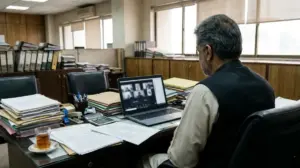
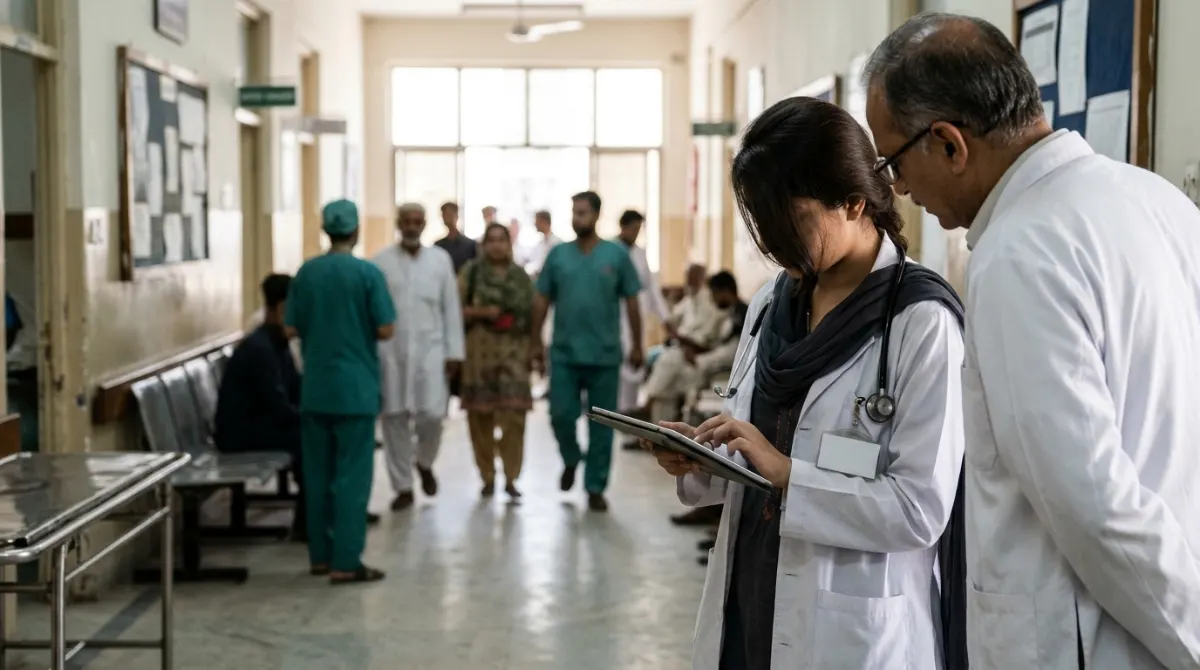
The University of Health Sciences (UHS) Lahore has launched PRIME, a digital medical training system that will track how doctors, dentists and other health students in Punjab are trained and assessed. The province-wide platform replaces paper logbooks with digital records and gives supervisors and the university a live view of clinical training across affiliated institutions.
Punjab’s Minister for Specialized Healthcare and Medical Education, Khawaja Salman Rafique, inaugurated the system at the UHS campus in Lahore. The university plans to bring the platform to medical, dental, nursing, pharmacy and allied health programmes in three phases.
What the PRIME digital medical training system does
For years, postgraduate trainees in Pakistan have recorded their clinical work in paper logbooks that supervisors sign by hand. These books are used to prove that a trainee has handled enough cases and procedures before sitting exams or moving to the next stage of training. They are also hard to audit, easy to lose and difficult to compare across hospitals.
According to UHS, PRIME moves this record-keeping online. Trainees will log clinical cases, procedures, attendance, rotations, research activity and performance assessments on the portal. Supervisors will be able to verify each entry, give feedback and follow a trainee’s progress over time.
The system also includes institutional dashboards. UHS says these will help it spot gaps in training at specific hospitals and judge whether education standards are being met across the province. In practice, this gives the university a data trail on training quality that paper logbooks could not provide.
UHS Vice Chancellor Maj Gen (Retd) Prof. Sohail Sabir said the platform would put the focus on practical clinical competence and verified professional skills, rather than paperwork alone.
Three phases, nearly 69,000 users
The rollout starts with postgraduate training. In the first phase, PRIME will cover about 3,300 postgraduate medical and dental trainees enrolled in MS, MD and MDS programmes at 33 training institutions. Around 1,100 supervisors will also be registered on the portal.
The second phase will extend the system to undergraduate and house-job training. This covers MBBS and BDS students and house officers, about 33,875 people across 60 institutions.
The third phase will add Nursing, Pharmacy and Allied Health Sciences programmes. UHS puts this group at about 31,734 students from 180 institutions.
Taken together, the three phases would bring close to 69,000 trainees and students onto a single digital platform, along with their supervisors. UHS has not yet announced dates for the second and third phases.
Why it matters for Punjab’s digital push
PRIME is a sector-specific system, but it fits a wider pattern in Punjab, where the provincial government has been moving training, services and record-keeping onto digital platforms. Earlier this week, ITInsider reported on the launch of the Mein Digital-II skills programme, another provincial initiative built around digital delivery.
For medical education, the shift has practical effects. Digital logbooks can be checked remotely, so a supervisor or examiner does not need the physical book to confirm a trainee’s work. Data from dozens of hospitals can be compared on one screen, which makes it easier to see where trainees are getting too few cases or where rotations are not being completed.
The move also creates new responsibilities. A platform holding clinical training records for tens of thousands of students and doctors will need strong data protection, reliable uptime in hospitals with uneven connectivity, and training for supervisors who are used to paper. UHS has not shared details of the technology vendor, hosting arrangements or data security measures behind PRIME.
Key facts
- Platform: PRIME, launched by the University of Health Sciences, Lahore
- Inaugurated by: Khawaja Salman Rafique, Punjab Minister for Specialized Healthcare and Medical Education
- Phase 1: about 3,300 MS, MD and MDS trainees at 33 institutions, plus about 1,100 supervisors
- Phase 2: about 33,875 MBBS and BDS students and house officers at 60 institutions
- Phase 3: about 31,734 Nursing, Pharmacy and Allied Health students at 180 institutions
- Replaces: paper logbooks for cases, procedures, attendance, rotations, research and assessments
FAQ
Who will use PRIME first?
Postgraduate medical and dental trainees in MS, MD and MDS programmes and their supervisors at 33 training institutions.
Will MBBS students use it?
Yes, in the second phase, along with BDS students and house officers. UHS has not given a start date for that phase.
What does it replace?
Paper logbooks used to record clinical cases, procedures, attendance, rotations, research work and assessments.
Official sources: University of Health Sciences, Lahore (launch of PRIME, statements by the UHS Vice Chancellor and the Punjab Minister for Specialized Healthcare and Medical Education)
Facts and figures checked against official sources by the ITInsider desk.
Featured image: representational, AI-generated