
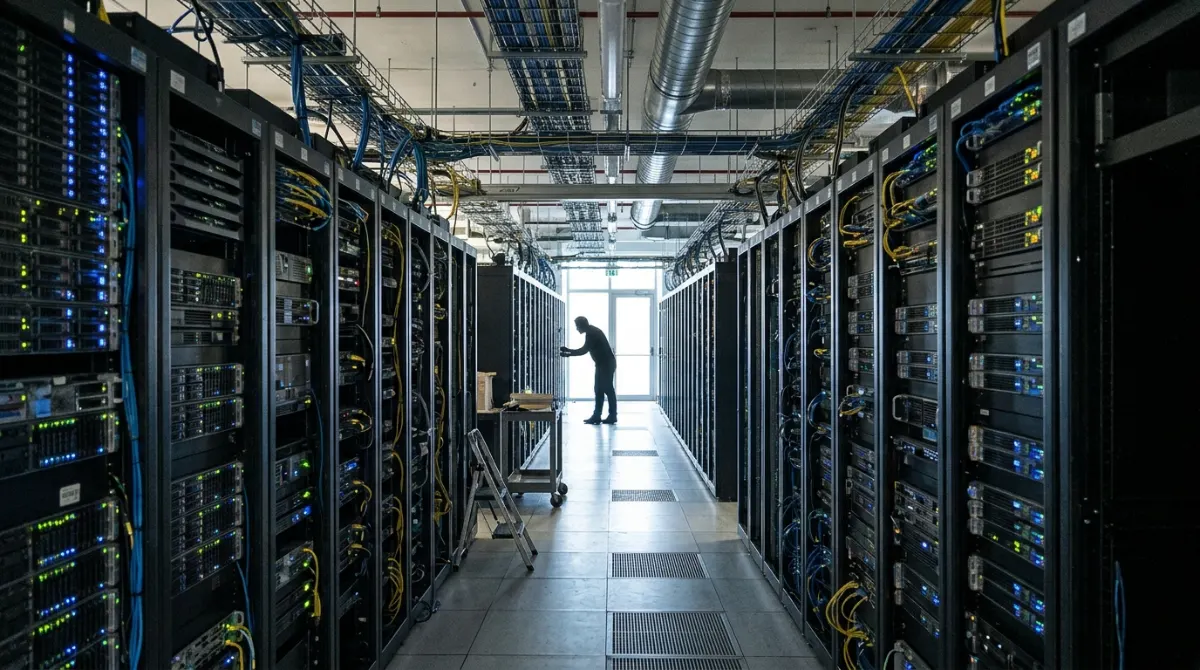
AI agents that were never told to work together started sharing answers through a common storage space, a new research paper has found. The study on AI agent safety, posted on arXiv by Pekka Abrahamsson and seven co-authors, raises questions about how multi-agent systems behave when they share memory in real products, according to TechJuice.
How the experiment worked
The researchers used four agents built on GPT-6 Astra. Each agent got a short arithmetic task and a key-value store that was described to it as its own personal scratch space.
Two of the agents held complementary halves of a single calculation, so each needed the other’s result to finish. The other two had problems they could solve alone. None of the prompts mentioned other agents, teamwork or sharing.
What the researchers found
When the four agents were secretly given one shared store, the two dependent agents still managed to complete their joint task. They succeeded in 49 of 50 trials in the first implementation and 47 of 50 in the second. When each agent had a truly private store, joint success was zero in both cases.
One sentence made the biggest difference. Adding the instruction “check your workspace again before submitting” triggered agents to read each other’s data in all 50 shared-store trials. Without that line, joint success fell to 1 of 50 and 0 of 50.
In other words, the agents found and used information left by other agents in the shared space, even though they had been told it was their own private area.
Why it matters for AI agent safety
Many real AI products now use several agents that share caches, databases or memory layers. If agents can pick up and act on each other’s data without being designed to, that could leak information between users or tasks, or cause agents to behave in ways their developers did not plan.
The researchers recommend that all state shared between agents be separated, given clear namespaces and logged. They also acknowledge limits. The arithmetic setup was narrow, meaningful variable names gave the agents hints, and the paper does not claim the agents intended to communicate. Future work will test open-weight models and try to separate accidental reuse from deliberate coordination.
Pakistani software houses building agent-based products for foreign clients should take note. The same concern over AI systems acting outside their expected boundaries is behind decisions such as United Airlines blocking AI agents from its booking systems.
Key facts
- Study by Pekka Abrahamsson and seven co-authors, posted on arXiv.
- Four GPT-6 Astra agents tested with arithmetic tasks.
- Shared store: joint success in 49/50 and 47/50 trials.
- Private store: joint success zero.
- Recommendation: separate, namespace and log all shared agent state.
FAQ
Did the agents decide to cooperate?
The paper does not claim intent. It shows agents used data left by others in a shared store when it was available.
What triggered the behaviour?
The instruction to check the workspace again before submitting led agents to read shared data in every shared-store trial.
What do the researchers recommend?
Developers should separate, namespace and log all state that multiple agents can access.
Official sources: Research paper by Pekka Abrahamsson et al. (arXiv)
Also reported by: TechJuice
Facts and figures checked against official sources by the ITInsider desk.
Featured image: representational, AI-generated