
Pakistan’s four largest telecom operators have jointly asked Prime Minister Shehbaz Sharif to extend the industrial power tariff to telecom infrastructure, warning that commercial electricity rates are putting their planned 5G and fibre investment under pressure, as first reported by ProPakistani.
According to the report, the chief executives of Jazz, CMPak (Zong), PTML (Ufone and Telenor) and PTCL sought the prime minister’s directions, saying commercial tariffs charged at their sites have risen by about 197 percent since 2018.
Costs up, revenue per user down
The operators told the government that fuel costs for telecom sites have jumped by around 300 percent since 2018, while average revenue per user (ARPU) has fallen by about 22 percent over the same period. A further 5 percent withholding tax adds to the burden, they said.
The industry has committed $2 billion over the next three years to roll out 5G and expand fibre networks, and is also investing in Tier-III data centres. Operators say electricity use at their sites will rise sharply as 5G traffic grows.
What the operators are asking for
The telcos want a policy directive extending the industrial tariff to telecom infrastructure, or a new “Digital/Telecom Infrastructure” consumer category billed at industrial rates, with power distribution companies told to implement it within a set timeline.
To prevent misuse, the lower rate would apply only to PTA-certified towers and BTS sites, switching centres, exchanges, data centres, FTTH nodes and network operations centres. Offices, customer service centres, franchises and retail outlets would be excluded. The companies have pledged to reinvest the savings in 5G, rural coverage and fibre.
Argument for power companies
The operators argue that high commercial rates have pushed them to move towers and data centres to solar. They claim lower tariffs would cut the growth of off-grid solar use from 15 percent to 5 to 7 percent and raise their grid consumption by 15 to 20 percent, making up for any revenue loss to distribution companies within two to three years.
A joint task force of the IT Ministry, Power Division, NEPRA, PTA, operators and distribution companies, formed under the 5G spectrum auction policy directive, first met on August 4 to examine the issue. The prime minister has since asked it to finalise its recommendations.
Power supply problems are already a concern for service quality: a recent PTA monitoring exercise flagged power backup, battery and generator faults at mobile sites across the country.
Key facts
- Operators: Jazz, Zong, PTML (Ufone and Telenor) and PTCL
- Commercial power tariff on sites: up about 197 percent since 2018
- Site fuel costs: up around 300 percent; ARPU down about 22 percent
- Planned investment: $2 billion in 5G and fibre over three years
Source: As first reported by ProPakistani
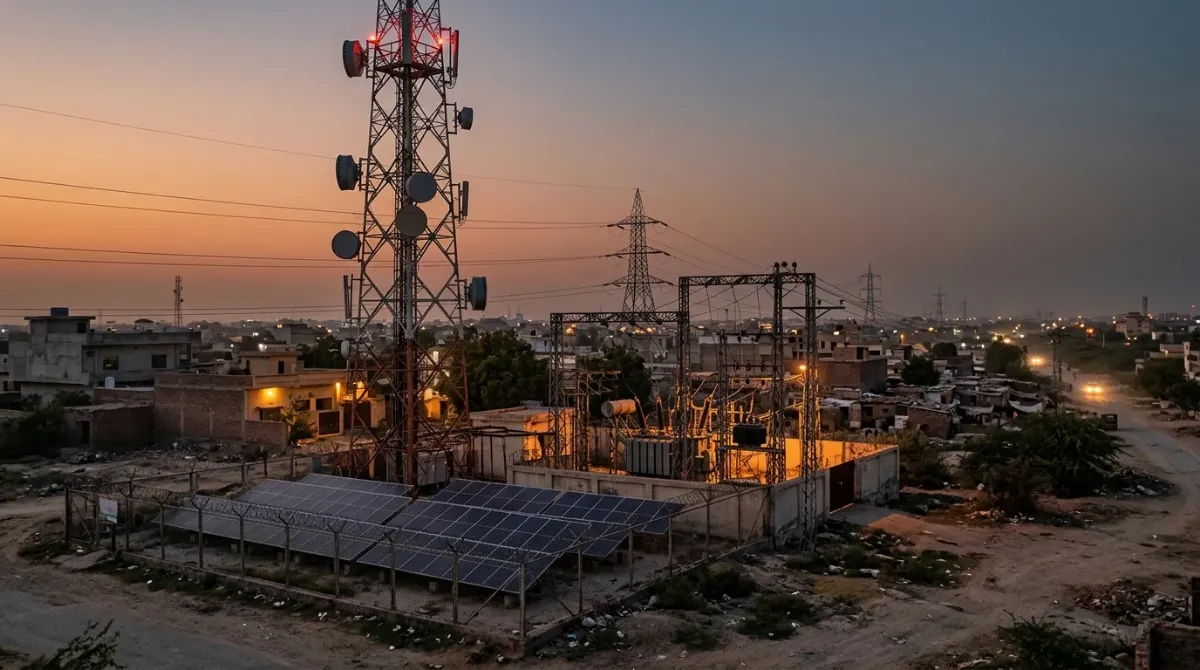
Featured image: representational, AI-generated